
Why Your Database Can Make or Break Your Product

Your UI might look flawless. The buttons are aligned. Colors pop. Animations are smooth. But if your data is wrong, your product is broken — no matter how pretty it looks.
Database testing isn’t glamorous. You don’t get applause for writing the perfect SQL query. But the truth is, real quality lives in your data, not your pixels.
The Hidden Chaos in Your Database
The backend is often where the sneaky bugs hide. Common issues include:
Referential integrity: Orphan records that break joins and reports.
Data accuracy: When inputs don’t match outputs, or numbers mysteriously shift.
Boundary conditions: Max, min, empty, null — all the edge cases your UI tests won’t catch.
Transactions & rollbacks: When something fails halfway and your system ends up in an inconsistent state.
Skip database testing, and your next sprint will be spent chasing ghosts in production instead of building features. 👻
Why UI Tests Aren’t Enough
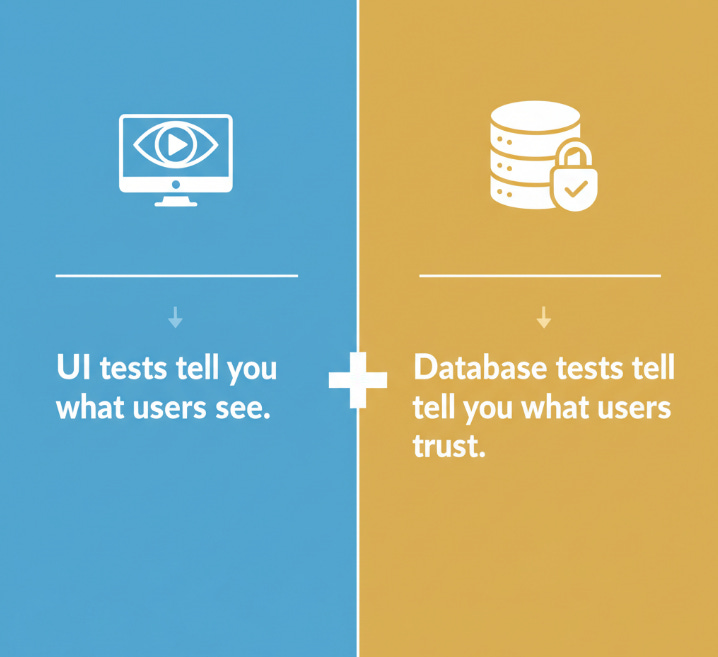
UI tests are important — they make sure your users see what you intend.
Database tests are different. They ensure that what the user sees is actually true.
Think of it like this: your UI is the face of your app; your database is the skeleton and organs. No amount of makeup will fix a broken spine.
Practical Steps for QA Teams
Here’s a quick checklist to get started:
Verify Referential Integrity – make sure all relationships between tables hold.
Check Data Accuracy – validate that every piece of data is correct across processes.
Test Boundaries – include extreme values, nulls, and invalid inputs.
Test Transactions & Rollbacks – ensure partial failures don’t corrupt data.
Automate where possible – write automated database checks in your CI/CD pipeline to catch regressions early.
Resources to Learn More

Database testing may not be glamorous, but it’s where your product’s trust and reliability live. Invest the time now, and you’ll save your team countless headaches — and your users a lot of frustration.